
-
MODULE 1 – CRITICAL ANALYSIS 13
In this module you will learn about who we are and why we reflect the world the way we do. We will see what discourse and framing are, or how our own brains can lead us astray.
-
Misleading maps (VIDEO)Minilekcia1.1
-
Second thoughtsMinilekcia1.2
-
On passing the ball (VIDEO)Minilekcia1.3
-
Story from Japan (VIDEO)Minilekcia1.4
-
Template of the ideas about the worldMinilekcia1.5
-
About Columbus (VIDEO)Minilekcia1.6
-
Stepping out of learned ideas about the worldMinilekcia1.7
-
Theoretical sensitivityMinilekcia1.8
-
Thomas theorem (VIDEO)Minilekcia1.9
-
Words matter (VIDEO)Minilekcia1.10
-
Power of discourseMinilekcia1.11
-
How to write about AfricaMinilekcia1.12
-
“Us” vs. “them”Minilekcia1.13
-
-
MODULE 2 - GLOBALISATION 20
The module will help you to understand the multidimensional phenomenon of globalisation with its pros and cons, important actors or perspectives that should not be forgotten. The content of the module has been commented and consulted by Dr. Vladan Hodulák from the Department of International Relations and European Studies at Masaryk University.
-
New era of global village (VIDEO)Minilekcia2.1
-
What is globalisation?Minilekcia2.2
-
Consequences and characteristics of globalisationMinilekcia2.3
-
3 types/dimensions of globalisationMinilekcia2.4
-
Positive consequensces of globalisationMinilekcia2.5
-
Negative impacts of globalisationMinilekcia2.6
-
AlterglobalismMinilekcia2.7
-
Multinational corporationsMinilekcia2.8
-
At the expense of the weak (VIDEO)Minilekcia2.9
-
Economic reality and inequalityMinilekcia2.10
-
Tariffs, quotas and other trade barriersMinilekcia2.11
-
Corporate dodging (VIDEO)Minilekcia2.12
-
Global supply chainMinilekcia2.13
-
The journey of a product (VIDEO)Minilekcia2.14
-
4 tricks companies use to evade taxMinilekcia2.15
-
How (much) tax countries loseMinilekcia2.16
-
Trade liberalisation and trade agreementsMinilekcia2.17
-
The EU and US trade policies – liberalisation with strings attachedMinilekcia2.18
-
Mutual dependencyMinilekcia2.19
-
Planetary boundaries and limits to growthMinilekcia2.20
-
-
MODULE 3 - MIGRATION 23
The module will help you to understand the phenomenon of migration in its complexities. We will show that it is one of the most natural social processes and introduce the concepts and challenges associated with it. The content of the module has been commented and reviewed by the RNDR. Tereza Freidingerová, Ph.D., Institute of Sociological Studies, Charles University.
-
Introduction to the module on migrationMinilekcia3.1
-
How to understand migration?Minilekcia3.2
-
On the move from the very beginning (VIDEO)Minilekcia3.3
-
From time immemorial to domesticated animals and cropsMinilekcia3.4
-
From early civilisations to overseas discoveriesMinilekcia3.5
-
From the beginnings of colonialism to industrialisationMinilekcia3.6
-
Modern migrationMinilekcia3.7
-
What is migration?Minilekcia3.8
-
Who is who in migration – migrants vs. refugeesMinilekcia3.9
-
Who is who in migration – economic migrants, asylum seekers, etc.Minilekcia3.10
-
Who is who in migration – emigrants vs. immigrantsMinilekcia3.11
-
What is what in migration? Asylum, subsidiary protection and temporary refugeMinilekcia3.12
-
What is what in migration? Asylum process and asylum politics of the EUMinilekcia3.13
-
Asylum vs. migration politicsMinilekcia3.14
-
Where people migrate to and from (VIDEO)Minilekcia3.15
-
Push and pull factors – or what motivations there are behind migration?Minilekcia3.16
-
Factors leading to non-migrationMinilekcia3.17
-
When it is not enough to differentiate between push and pullMinilekcia3.18
-
Climate migrationMinilekcia3.19
-
Do foreigners take our jobs? (VIDEO)Minilekcia3.20
-
I am not always welcome (VIDEO)Minilekcia3.21
-
Integration and assimilationMinilekcia3.22
-
Data and sources on migrationMinilekcia3.23
-
-
MODULE 4 - POVERTY 9
This module will help you to understand poverty as a complex social phenomenon. It is a phenomenon that can be found in every country in the world, in every single society. And, as we will show, it has not only economic but also social and psychological consequences. The content of the videos has been commented and reviewed by Mgr. Daniel Gerbery, Ph.D. from the Department of Sociology, Faculty of Arts, Comenius University.
-
Forms of povertyMinilekcia4.1
-
From poverty to prosperity (VIDEO)Minilekcia4.2
-
The vicious circle of povertyMinilekcia4.3
-
Poverty traps (VIDEO)Minilekcia4.4
-
Focus on women (VIDEO)Minilekcia4.5
-
Inequalities (VIDEO)Minilekcia4.6
-
Situational and intergenerational povertyMinilekcia4.7
-
Poverty and climate change (SHORT TEXT)Minilekcia4.8
-
Different ways of measuring povertyMinilekcia4.930 min
-
-
MODULE 5 - GENDER EQUALITY 10
The module will help you to understand issues related to gender (in)equality. We will explain what gender is as a social category and how it affects our lives. We will introduce the concepts associated with it and the challenges it poses. The content of the module was commented and reviewed by Dr. Monika Bosá, Ph.D. from the Faculty of Arts, University of Prešov.
-
IntroductionMinilekcia5.1
-
Albanian sworn virgins (VIDEO)Minilekcia5.2
-
Gender vs. sex (VIDEO)Minilekcia5.3
-
Gender role (VIDEO)Minilekcia5.4
-
Gender stereotypesMinilekcia5.5
-
The line of (in)equality (VIDEO)Minilekcia5.6
-
Equality vs. samenessMinilekcia5.7
-
Motherhood penaltyMinilekcia5.8
-
Glass ceilingMinilekcia5.9
-
Unpaid workMinilekcia5.10
-
-
MODULE 6 - CLIMATE CHANGE 9
The module will help you understand climate change as the most important global challenge we face as a human race. We will explain that it is not so much an ecological issue as a civilisational one. The content of the videos has been commented and reviewed by climatologist Jozef Pecho from the Slovak Hydrometeorological Institute.
-
Through the eyes of the planet (VIDEO)Minilekcia6.1
-
How the global temperature is risingMinilekcia6.2
-
Climate tipping points (VIDEO)Minilekcia6.3
-
Global North versus South (VIDEO)Minilekcia6.4
-
Carbon taxMinilekcia6.5
-
Climate vs. weatherMinilekcia6.6
-
Development scenariosMinilekcia6.7
-
CO2 equivalentMinilekcia6.8
-
How CO2 increases in the atmosphereMinilekcia6.930 min
-
Poverty and climate change (SHORT TEXT)
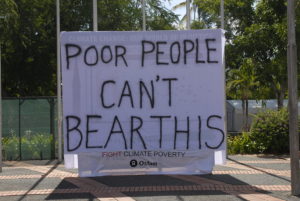
The poor are much more vulnerable to the environmental shocks associated with climate change. This is shown in publication Environment and Development Economics. It also shows, for example, that:
- Poorer countries are much more vulnerable to natural disasters and the devastating effects of climate change. They have insufficient funds for adaptation, their infrastructure is in poor condition and they lack technology.
- Poor people are more likely to lose their property in disasters such as floods and storms. They also find it harder to get out of the situation, partly because they have no savings.
- Governments in less developed countries are more likely to support the middle class than the poorest after disasters.
- Disasters in less developed countries usually result in children having less to eat and their education being interrupted. This has lifelong consequences and affects their future income.
- Many natural disasters cause food prices to rise. Again, the poorest are much worse off. They spend a large proportion of their income on food.